
Want stronger fingers and harder sends? Discover my six favorite finger-strength training exercises—and learn how to train for both maximum strength and strength-endurance to unlock your climbing potential! (Banner photo: ID 41129328 @ Elodiesaracco)
Want to climb harder? Then you’d better develop stronger fingers!
Every climber who’s ever fired off a small hold or battled through a desperate sequence with pumped forearms knows that finger strength is one of the most important physical attributes for climbing performance. Whether you’re pulling on tiny crimps, slick slopers, two-finger pockets, or desperate pinch grips, your ability to generate—and sustain—force through your fingers is fundamental to success.
But what’s the best way to train finger strength?
First, it’s important to distinguish between two related but distinct training objectives:
- Maximum (Limit) Finger Strength: Your ability to generate the greatest possible force in a specific grip position. This is best developed through high-intensity loading, typically using heavy resistance and brief, near-maximal contractions. Developing maximum finger strength is the primary focus of this article.
- Finger Strength-Endurance: Your ability to repeatedly generate relatively high forces while resisting fatigue. Developing this capacity generally requires somewhat lighter loading, more repetitions, or longer-duration contractions, depending on the training protocol.
Both qualities are essential for climbing performance, although their relative importance depends on the type of climbing you do. A powerful boulderer may prioritize maximum finger strength, while a sport climber tackling long, sustained routes also needs exceptional finger strength-endurance.
With that distinction in mind, let’s explore my six favorite exercises for developing stronger fingers and improving your climbing performance!
1. Climbing! (Duh, You Say!)
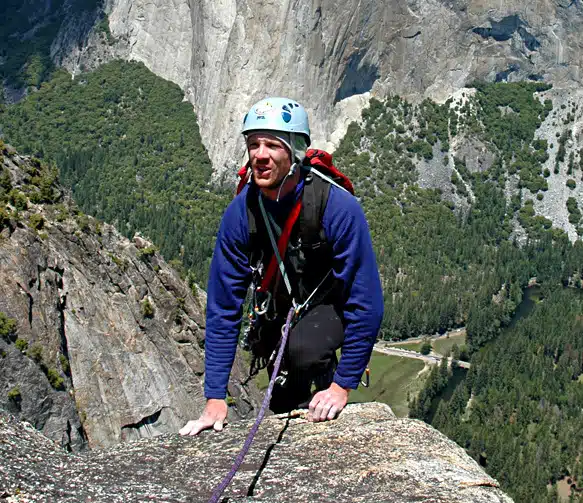
Yes, climbing itself—and limit bouldering in particular—is arguably the most sport-specific way to develop finger strength!
Finger strength is highly specific to joint angles, grip positions, and muscle contraction types. Climbing challenges your finger flexors through a variety of movements and loading patterns that are difficult to replicate with conventional exercises. And naturally, the brutally difficult grips and powerful movements encountered during limit bouldering demand near-maximal recruitment of the finger flexor muscles. Consequently, simply climbing a few days per week provides an excellent sport-specific finger-strength training stimulus.
The limitations? Climbing doesn’t reliably target specific grip positions with consistent, progressive loading. Furthermore, resistance is largely determined by your body weight, although wall angle, hold size, and movement dynamics dramatically influence the actual forces exerted on your fingers.
For these reasons, serious climbers can benefit from supplemental finger-strength training to target specific grip positions, progressively overload the finger flexors, and systematically develop greater maximum strength—as detailed below.
2. Hangboard Training: The Gold Standard
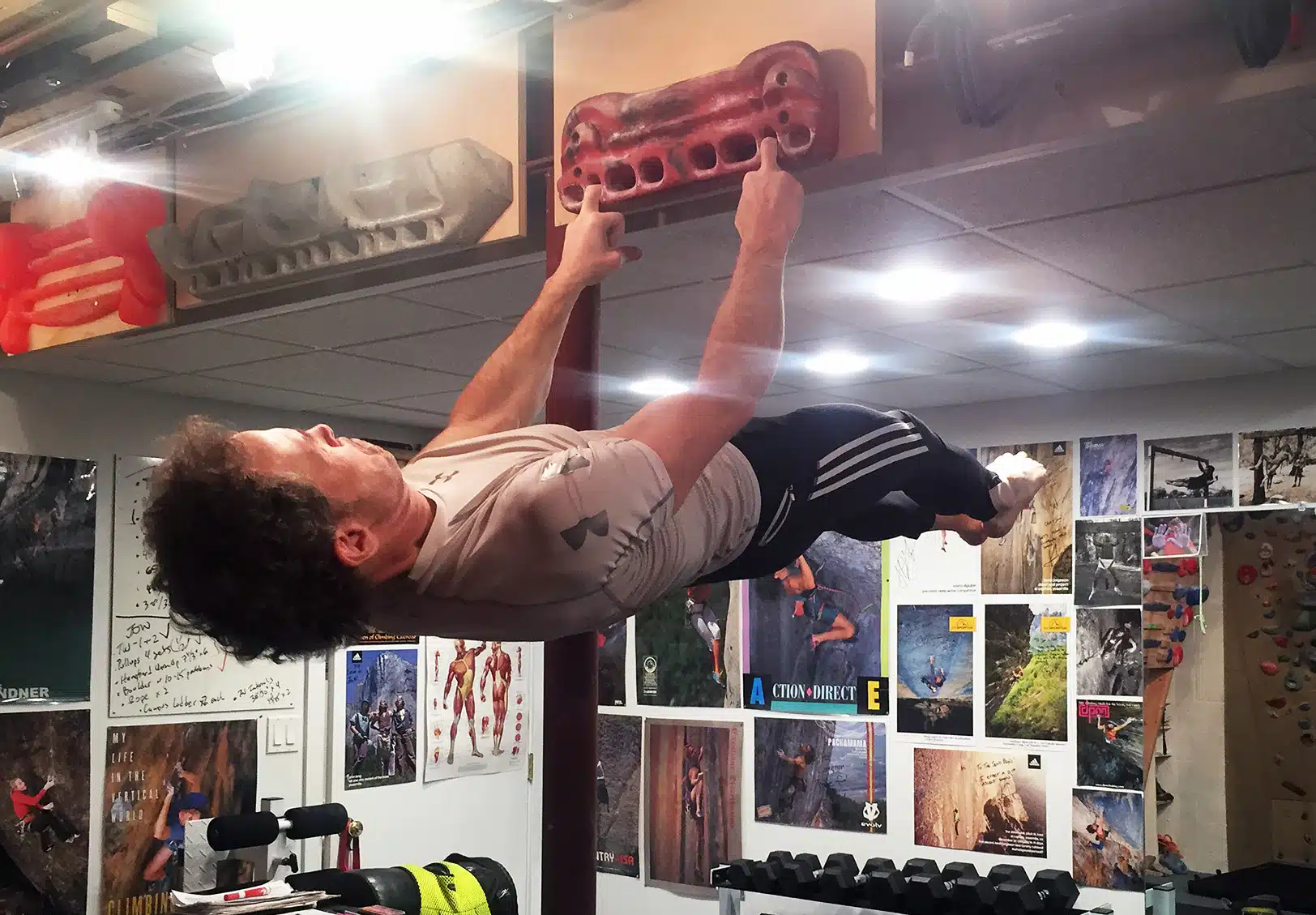
The hangboard is the granddaddy of supplemental finger-strength training—and for good reason! Hangboarding provides highly specific, measurable, and progressively adjustable loading of the finger flexors.
You can increase difficulty by adding weight, using smaller edges, or modifying the amount of assistance provided. You can also systematically target specific grip positions, such as the half-crimp and open-hand grip.
For maximum strength, perform a few brief, high-intensity hangs with ample rest between efforts. To develop strength-endurance, use somewhat lighter loading and perform repeated hangs with relatively short recovery intervals.
Best of all, hangboard workouts are easily quantified and tracked, allowing you to objectively measure improvements over time.
And with a portable hangboard, you can train virtually anywhere!

3. Edge Lifting and Overcoming Isometrics
Edge lifting has surged in popularity as an effective alternative—or complement—to traditional hangboarding.
Using a portable lifting edge attached to weights, you can progressively overload your finger flexors while measuring and tracking your strength gains.
Lifting edges come in several designs, including flat and ergonomically contoured edges that can help distribute loading more evenly across the fingers.
Another variation is overcoming isometric training, in which you pull against an immovable edge while measuring force with a digital force gauge.
Unlike conventional edge lifting, which involves raising a weight through a short range of motion, overcoming isometrics involve producing high muscular force without movement.
Both methods are particularly useful for developing maximum finger strength, although repeated submaximal contractions can also provide a strength-endurance stimulus.
(Photos below: Half-crimp grip max edge lift with Tension Block and Lattice Loading Pin. Right: Overcoming isometric with the PitchSix Force Board & Gauge.)

4. Weighted Fingertip Pull-Ups
Here’s an advanced exercise that combines finger strength with powerful upper-body pulling!
Performing pull-ups while gripping a hangboard edge challenges your finger flexors under substantial loading while simultaneously strengthening your pulling muscles.
For advanced climbers, adding weight with a harness or weight belt can create an exceptionally demanding, climbing-specific strength exercise.
For maximum strength, use enough resistance to limit yourself to approximately 5 controlled repetitions, with generous rest between sets. After a thorough warm-up, perform 3 sets on a hold that’s slightly less than first-finger-pad depth (~20mm).
For strength-endurance, use less resistance and perform additional repetitions, provided you can maintain secure finger positions and controlled movement.
One caution: Weighted fingertip pull-ups place considerable stress on the fingers and elbows. Build a foundation of finger strength before attempting heavy loading, and avoid explosive movements or sudden loading of your fingers. This is not a beginner-level exercise!
5. Barbell or Dumbbell Finger Rolls
Here’s an old-school exercise that deserves more attention! It was a favorite of my friend the legendary Todd Skinner. RIP
Finger rolls train the finger flexors through both concentric (shortening) and eccentric (lengthening) muscle contractions.
Holding an Olympic barbell (ideal) or dumbbells, slowly open your fingers to let the weight roll toward your fingertips, then powerfully curl your fingers to return the weight into your palm.
For maximum strength development, select a challenging load—stronger climbers may need to use their body weight or more when performing two-handed finger rolls with an Olympic barbell—that limits you to approximately 5–10 controlled repetitions. To emphasize local muscular endurance, use substantially lighter resistance and perform 20 or more repetitions per set.
Although less climbing-specific than hangboarding or edge lifting, finger rolls provide a useful dynamic strengthening stimulus.
6. Wrist Curls and Reverse Wrist Curls
Here’s an often-overlooked piece of the finger-strength puzzle!
Your finger flexors don’t work in isolation. They cross the wrist joint, meaning wrist position and stability influence your ability to produce gripping force.
Wrist curls and reverse wrist curls strengthen the wrist flexors and extensors, respectively—muscles that help stabilize your wrist during demanding climbing movements.
While these exercises don’t directly train climbing-specific finger strength, they can improve forearm strength, muscular balance, and wrist control. Use heavier weights and lower repetitions to emphasize strength, or lighter resistance and higher repetitions to develop muscular endurance.
The takeaway: Strong fingers are essential, but don’t neglect the supporting musculature of your forearms!

Final Thoughts: Train Your Fingers Intelligently!
These six exercises provide a versatile toolkit for building stronger fingers and more capable forearms.
But remember: The exercise is only part of the equation. The training protocol determines much of the result!
Training maximum finger strength generally requires high loads, brief efforts, and substantial recovery between sets. Developing strength-endurance typically involves moderate-to-high relative loading, more repetitions or longer time under tension, and shorter recovery intervals.
The optimal number of sets, repetitions, loading intensity, and weekly training frequency depends on your current strength, training experience, recovery capacity, and injury history. And because tendons and pulleys generally adapt more slowly than muscles, progressive loading and adequate recovery are essential.
For detailed finger-strength training protocols, consult an experienced climbing coach or check out my book, Training for Climbing.
Train smart. Build stronger fingers. Climb harder!
PRO TIP: Nourish Your Tendons and Joints Before Each Climbing Workout!
A growing body of research has demonstrated the benefits of a specific pre-exercise nutritional protocol designed to amplify collagen synthesis and soft tissue recovery. Consuming vitamin C-enriched hydrolyzed collagen before rigorous training is the lynchpin of the protocol shown to support connective tissue remodeling and recovery from powerful workouts. This is revolutionary information for a hard-training climber! Read more about the 10 evidence-based benefits of collagen use >>
Copyright © 2000–2026 Eric J. Hörst | All Rights Reserved.